I was standing in the produce aisle of our local grocery store last November when a woman brushed past me carrying a bag of Fuyu persimmons. The smell—that faint, honeyed sweetness with something almost like cinnamon hiding underneath—hit me, and suddenly I was nine years old at my Aunt Lena’s kitchen table in Portland. She’d set a slice of something dark and glistening in front of me, and I remember thinking it looked like a jewel. The top was sticky and caramel-colored, and when I took a bite, the fruit melted into the cake in a way I couldn’t quite understand at the time. I just knew it was the best thing I’d ever eaten. I never got the recipe from her before she passed, and for years I’ve been trying to get back to that exact moment.
Honestly, I’ve made a lot of terrible persimmon cakes in the process. Too dry, too wet, not sweet enough, the fruit sinking to the bottom like a rock. But last fall, after maybe my tenth attempt, I finally cracked it. The secret, I learned, is in the caramel. You have to let it go just past golden, to that deep amber stage where it smells almost nutty. And you have to slice the persimmons thin enough that they almost disappear into the sugar, leaving behind just their flavor and that soft, almost jelly-like texture.
This cake has become my signature for fall gatherings. Every time I bring it to a dinner party, someone asks for the recipe. And every time I make it, I think of Aunt Lena’s kitchen, the way the steam fogged up her glasses, and how she’d always sneak me an extra piece when no one was looking. Maybe you’ve had that feeling—trying to recreate a taste from your past, something that feels just out of reach. This cake is as close as I’ve gotten. And I think you’re going to love it.
Why You’ll Love This Recipe
Let me tell you why this cake has become my go-to for every fall gathering, from Thanksgiving to casual dinner parties. It’s not just another upside-down cake—it’s the one that gets the “oh wow” reaction every single time.
- Show-Stopping Presentation : When you flip this cake onto a plate, the top is a glossy, caramelized mosaic of persimmon slices that looks like stained glass. It’s the kind of dessert that makes people pull out their phones before they even take a bite.
- Perfect for Hosting : You can make this cake a day ahead—actually, it tastes better the next day. The caramel soaks into the cake overnight, making it even more moist and flavorful. That means less stress when guests arrive.
- Unexpected Flavor : Persimmons have this unique flavor that’s somewhere between apricot, honey, and a hint of pumpkin pie spice. Most people have never had them baked into a cake, so it feels special and unexpected.
- Simple Ingredients : Despite how fancy it looks, the ingredient list is surprisingly short. Butter, sugar, eggs, flour, and persimmons. That’s really the heart of it. No weird extracts or hard-to-find items.
- Crowd-Pleaser : I’ve served this to kids who said they don’t like fruit desserts, and to adults who claimed they were too full for sweets. Both groups came back for seconds. It’s that good.
What makes this recipe different from other upside-down cakes is the caramel technique. Most recipes just melt butter and brown sugar, which gives you a sticky bottom but not that deep, complex caramel flavor. Here, we’re making a proper caramel—letting the sugar cook until it’s amber and fragrant—before adding the butter. It takes an extra five minutes, but the difference is night and day. The caramel doesn’t just sit on top; it infuses the entire cake with a toasty, butterscotch-like richness that complements the persimmons perfectly.
This isn’t just a recipe—it’s the kind of dessert that makes you close your eyes after the first bite. It’s comfort food elevated, the kind of cake that feels both rustic and elegant at the same time. Perfect for impressing guests without stress, or turning an ordinary fall evening into something memorable.
What Ingredients You Will Need
This recipe uses simple, wholesome ingredients to deliver that deep caramel flavor and tender, moist crumb. Most of these are pantry staples, but the persimmons are the star—they need to be just right.
For the Caramel Topping
- 1 cup (200g) granulated sugar – Regular white sugar works best here. Don’t substitute brown sugar for the caramel base; we want that clean, amber caramel flavor.
- 6 tablespoons (85g) unsalted butter, cut into cubes – I use Kerrygold or Plugrá for their higher butterfat content, which makes the caramel richer. Let it come to room temperature before you start.
- 1/4 cup (60ml) heavy cream – Room temperature is crucial here. Cold cream will make the caramel seize up. If you’re dairy-free, full-fat coconut cream works surprisingly well.
- 1/2 teaspoon vanilla extract – Pure vanilla, not imitation. Trust me on this one.
- 1/4 teaspoon salt – A flaky salt like Maldon is nice for finishing, but regular fine salt works for the caramel itself.
For the Persimmon Layer
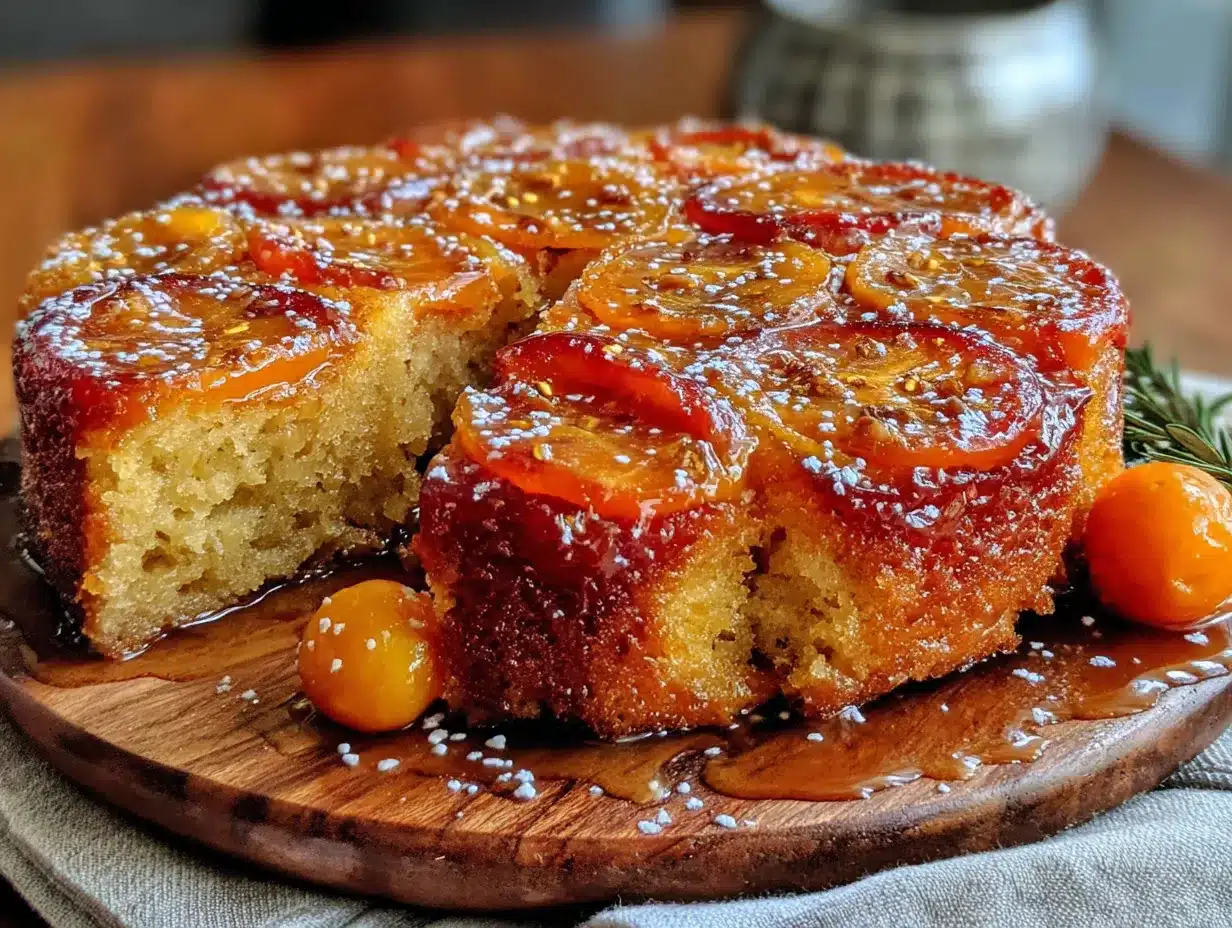
- 3-4 Fuyu persimmons – This is important: use Fuyu persimmons, not Hachiya. Fuyus are squat and firm, like a tomato, and they hold their shape when baked. Hachiyas are acorn-shaped and astringent until fully ripe—they’ll turn to mush. Look for persimmons that are firm but give slightly when pressed, with deep orange color. I’ve found the best ones at Asian grocery stores or farmers markets in late fall.
- 1 tablespoon lemon juice – This prevents the persimmons from browning and adds a tiny bit of acidity to balance the sweetness.
For the Cake Batter
- 1 1/2 cups (190g) all-purpose flour – Spoon and level your flour for accurate measuring. Too much flour makes the cake dense.
- 1 1/2 teaspoons baking powder – Make sure it’s fresh. Test it by dropping a bit into hot water—it should bubble vigorously.
- 1/2 teaspoon baking soda
- 1/2 teaspoon salt
- 1 teaspoon ground cinnamon – I prefer Saigon cinnamon for its stronger, sweeter flavor.
- 1/2 teaspoon ground ginger
- 1/4 teaspoon ground nutmeg – Freshly grated if you have it.
- 1/2 cup (113g) unsalted butter, softened – Let it sit out for at least an hour. You want it soft enough that your finger leaves an indent when you press it.
- 3/4 cup (150g) packed light brown sugar – Dark brown sugar works too, but it will make the cake slightly more molasses-y.
- 2 large eggs, room temperature – Cold eggs will make the batter curdle. Put them in a bowl of warm water for 5 minutes if you forgot to take them out.
- 1 teaspoon vanilla extract
- 1/2 cup (120ml) buttermilk, room temperature – If you don’t have buttermilk, add 1/2 tablespoon of lemon juice or vinegar to regular milk and let it sit for 5 minutes.
Equipment Needed
You don’t need anything fancy here, but a few specific tools make the process much smoother.
- 9-inch round cake pan – A light-colored metal pan works best. Dark pans can cause the caramel to burn. Glass or ceramic pans also work, but you may need to add 5-10 minutes to the baking time.
- Small saucepan – For making the caramel. A light-colored pan helps you see the color change.
- Electric mixer – Hand mixer or stand mixer with paddle attachment. You can do this by hand, but your arm will get tired.
- Sharp knife or mandoline – For slicing the persimmons evenly. A mandoline gives you perfectly uniform slices, which makes for a prettier cake. I use a Benriner mandoline—it’s about $30 and worth every penny.
- Parchment paper – Don’t skip this. The caramel can stick stubbornly, and parchment ensures clean release.
- Cooling rack – Essential for even cooling and preventing a soggy bottom.
- Large plate or cake stand – For the dramatic flip. Make sure it’s larger than your cake pan.
If you don’t have a mandoline, just use a sharp chef’s knife and try to slice as evenly as possible. The persimmons should be about 1/8-inch thick—thin enough to soften during baking but thick enough to hold their shape.
Preparation Method
Take your time with this one. The caramel is the most important part, and rushing it is the number one mistake people make. Set aside about an hour and a half total, with 20 minutes of active prep and 50-55 minutes of baking time.
Step 1: Prepare the Persimmons
Wash the persimmons and cut off the tops. Using a sharp knife or mandoline, slice them into 1/8-inch thick rounds. You want them thin enough to cook through but thick enough to hold their shape. Place the slices in a bowl and toss gently with the lemon juice. Set aside while you make the caramel.
Step 2: Make the Caramel
In a small saucepan, spread the granulated sugar in an even layer. Cook over medium heat, without stirring, until the sugar starts to melt around the edges. This takes about 3-4 minutes. Once you see liquid forming, gently swirl the pan (don’t stir) to help the sugar melt evenly. Continue cooking until the caramel turns a deep amber color—think the color of an old penny. This is where most people pull it too early. You want it dark enough that it smells nutty and almost smoky, but not so dark that it burns. When it reaches that color, immediately remove from heat.
Carefully add the butter cubes—the mixture will bubble up vigorously. Whisk until the butter is completely melted and incorporated. Slowly pour in the heavy cream while whisking constantly. The caramel will steam and bubble again. Whisk until smooth, then add the vanilla and salt. Pour the caramel into your prepared cake pan, tilting to coat the bottom evenly. Let it cool for 5 minutes—it needs to thicken slightly before you add the persimmons.
Step 3: Arrange the Persimmons
Starting from the center of the pan, arrange the persimmon slices in concentric circles, overlapping them slightly. You want them to form a tight, beautiful pattern—this will be the top of your cake. If you have extra slices, you can tuck them in around the edges. Press them gently into the caramel so they’re evenly coated. Set the pan aside.
Step 4: Make the Cake Batter
Preheat your oven to 350°F (175°C). In a medium bowl, whisk together the flour, baking powder, baking soda, salt, cinnamon, ginger, and nutmeg. Set aside.
In a large bowl, beat the softened butter and brown sugar together on medium speed until light and fluffy, about 3-4 minutes. Scrape down the sides of the bowl. Add the eggs one at a time, beating well after each addition. Stir in the vanilla extract.
With the mixer on low speed, add the flour mixture in three additions, alternating with the buttermilk in two additions. Start and end with the flour mixture. Mix just until combined—overmixing will make the cake tough. The batter will be thick and fluffy.
Step 5: Assemble and Bake
Spoon the batter over the persimmon layer, spreading it gently and evenly. Don’t pour it all in one spot, or you’ll disturb your beautiful persimmon arrangement. Use a spatula to smooth the top.
Bake for 45-55 minutes, until a toothpick inserted in the center comes out clean or with just a few moist crumbs. The cake should be golden brown and pulling away from the edges of the pan slightly. If the top is browning too quickly (after about 30 minutes), tent it loosely with foil.
Step 6: The Flip
Let the cake cool in the pan for exactly 10 minutes—no more, no less. If you flip it too soon, the caramel will run everywhere. If you wait too long, the caramel will harden and stick to the pan. After 10 minutes, run a knife around the edges of the pan. Place your serving plate upside down on top of the cake pan. With one hand on the plate and one on the pan, confidently flip the whole thing over. Lift the pan off slowly—if any persimmon slices stick, just press them back into place. The cake should release cleanly, with the caramel glistening on top.
Let the cake cool completely before slicing—about 2 hours. The caramel needs time to set, and the cake needs to finish cooking through from its own residual heat. I know it’s tempting, but warm cake will fall apart when you cut it.
Cooking Tips & Techniques
I’ve made this cake probably twenty times, and I’ve learned a few things the hard way. Let me save you some trouble.
The caramel is everything. The biggest mistake people make is pulling the caramel too early. You want it dark amber—almost to the point where you think it might be burning. That’s when the flavor is deep and complex, not just sweet. If you pull it when it’s light golden, you’ll get a sugary glaze instead of that rich, almost bitter caramel that makes this cake special. That said, watch it carefully. Caramel can go from perfect to burnt in about 15 seconds. When in doubt, err on the side of darker—it’s better to have a slightly bitter note than a flat, one-dimensional sweetness.
Temperature matters more than you think. All your ingredients should be at room temperature—butter, eggs, buttermilk, even the cream for the caramel. Cold ingredients will make the batter curdle and the caramel seize. I’ve forgotten to take my eggs out of the fridge more times than I’d like to admit. If you’re in a rush, put the eggs in a bowl of warm water for 5 minutes, and microwave the buttermilk for 10 seconds. It’s not perfect, but it works.
Don’t overmix the batter. Once you add the flour, mix just until you don’t see any more streaks. Overmixing develops gluten, which makes the cake tough and dense instead of tender and fluffy. I speak from experience—my first few attempts were more like hockey pucks than cake.
Timing the flip is critical. Set a timer for 10 minutes as soon as the cake comes out of the oven. I’ve ruined a cake by getting distracted and letting it cool for 20 minutes—the caramel had set so hard that half the topping stayed in the pan. On the flip side, I’ve flipped too early and watched caramel run all over the plate like a sticky waterfall. Ten minutes is the sweet spot.
Let it cool completely. I know, I know. The smell is incredible, and you want to dig in. But warm cake will crumble when you cut it, and the caramel will be runny. Give it at least 2 hours. The cake actually tastes better the next day anyway—the caramel soaks into the cake and everything melds together beautifully.
Variations & Adaptations
This cake is pretty forgiving, and I’ve played around with it quite a bit. Here are some variations that work well.
Apple-Persimmon Combo : If you can’t find enough ripe persimmons, substitute one or two with a firm apple like Honeycrisp or Granny Smith. Slice them the same thickness as the persimmons and arrange them together. The apple adds a nice tartness that balances the sweet caramel. I did this last fall when persimmons were scarce, and honestly, it might be my new favorite version.
Spice It Up : The cinnamon-ginger-nutmeg combo is classic, but you can play with the spices. Cardamom adds an interesting floral note—add 1/2 teaspoon along with the other spices. Or try a pinch of cloves and allspice for a more traditional pumpkin pie vibe. I’ve even added a pinch of black pepper once, which gave it a subtle warmth that was surprisingly good.
Gluten-Free Option : Substitute the all-purpose flour with a good 1:1 gluten-free baking flour blend. I like King Arthur’s Measure for Measure blend. The texture will be slightly more tender and a bit crumblier, but it works. Add 1 teaspoon of xanthan gum if your blend doesn’t already include it.
Dairy-Free Version : Use vegan butter (I prefer Miyoko’s for baking) and full-fat coconut cream instead of heavy cream. For the buttermilk, mix 1/2 cup of unsweetened almond milk with 1/2 tablespoon of lemon juice. The cake will be slightly less rich, but still delicious.
Individual Mini Cakes : This works beautifully in 6-ounce ramekins or a muffin tin. Reduce the baking time to 20-25 minutes. They’re perfect for dinner parties—everyone gets their own little cake, and you don’t have to deal with slicing.
Serving & Storage Suggestions
This cake is beautiful on its own, but a few simple additions make it even more special.
How to Serve : Let the cake come to room temperature before serving—about 30 minutes out of the fridge. Slice it with a sharp serrated knife, wiping the blade clean between cuts for neat slices. Serve each slice with a dollop of lightly sweetened whipped cream or a scoop of vanilla bean ice cream. The cold creaminess against the sticky caramel and tender cake is pure magic. For a fall twist, try cinnamon whipped cream: add 1/2 teaspoon of cinnamon and a tablespoon of maple syrup to 1 cup of heavy cream before whipping.
What to Serve Alongside : This cake is rich enough to stand alone, but it pairs beautifully with a cup of hot coffee or chai tea. If you’re serving it as part of a larger meal, it goes well after a hearty roast chicken or a warm autumn salad. For a full fall spread, serve it alongside a spiced apple cider for a cozy evening.
Storage : Store leftover cake in an airtight container at room temperature for up to 2 days, or in the refrigerator for up to 5 days. The caramel will soften the cake slightly over time, which I actually love. If you’re storing it in the fridge, let it come to room temperature before serving—the texture is much better.
Freezing : This cake freezes beautifully. Wrap the completely cooled cake (unflipped, in the pan) tightly in plastic wrap, then foil. Freeze for up to 3 months. To serve, thaw overnight in the refrigerator, then reheat in a 300°F oven for 10-15 minutes before flipping. Or you can freeze individual slices for quick desserts.
Reheating : For that just-baked warmth, reheat individual slices in a 300°F oven for 5-7 minutes, or in the microwave for 15-20 seconds. Be careful not to overheat, or the caramel will turn into syrup and run off the cake.
Nutritional Information & Benefits
Let’s be real—this is a dessert, and it’s meant to be indulgent. But there are a few redeeming qualities worth mentioning.
Estimated per slice (1/10 of cake) : Calories: 320 | Fat: 18g | Carbs: 38g | Protein: 4g | Fiber: 2g | Sugar: 24g
Persimmons are actually good for you : They’re packed with vitamin A (great for eye health), vitamin C, and fiber. One persimmon has about 6 grams of fiber, which is more than an apple. They also contain antioxidants called flavonoids that help reduce inflammation. So while the cake itself isn’t health food, the persimmons are doing some good work in there.
Dietary Considerations : This recipe contains dairy, eggs, and gluten. For gluten-free, dairy-free, or vegan options, see the variations section above. The cake is naturally nut-free if that’s a concern.
My perspective : I believe in enjoying dessert without guilt. This cake is special—it’s for celebrations, for gathering with people you love, for those moments when you want something truly memorable. One slice won’t derail your healthy eating habits. And honestly, the joy of sharing something this delicious with friends and family is good for your soul, which counts for something too.
Conclusion
This sticky caramel persimmon upside-down cake has become my fall signature, and I think it’s going to become yours too. It’s the kind of dessert that looks like you spent hours on it—but really, it’s just a simple cake with a show-stopping caramel topping and some beautifully arranged fruit. The persimmons add a subtle, honeyed sweetness that’s unlike anything else, and the caramel is deep and complex in a way that store-bought versions just can’t match.
What I love most about this cake is how it brings people together. Every time I make it, someone asks for the recipe. Every time I serve it, there’s a moment of silence after the first bite—that pause where everyone is just enjoying what’s in front of them. That’s the kind of cooking I love: food that makes people stop and pay attention.
I’d love to hear how yours turns out. Did you try a variation? Did your guests love it? Drop a comment below and let me know. And if you’re looking for another fall dessert to add to your rotation, you might enjoy my maple pecan tart—it has that same cozy, impressive vibe. Happy baking, friends. I hope this cake brings you as much joy as it’s brought me.
Frequently Asked Questions
Can I use Hachiya persimmons instead of Fuyu?
I wouldn’t recommend it. Hachiya persimmons are astringent until they’re fully ripe, and even then, they’re very soft and jelly-like inside. They’ll turn to mush in the cake and won’t hold their shape for the beautiful top layer. Stick with Fuyu persimmons—they’re firm, sweet, and hold up perfectly to baking. If you can only find Hachiyas, you can use them to make persimmon pulp for a different recipe, but not for this one.
Why did my caramel turn out grainy?
Grainy caramel usually happens when sugar crystals form during cooking. This can happen if you stir the sugar while it’s melting (which introduces crystals) or if your equipment isn’t perfectly clean. To avoid this, just swirl the pan gently instead of stirring, and make sure your saucepan is spotless. If your caramel does crystallize, you can try adding a tablespoon of water and gently reheating it to dissolve the crystals. Sometimes it works, sometimes it doesn’t—but it’s worth a try.
Can I make this cake ahead of time?
Absolutely. In fact, I prefer to make it a day ahead. The caramel soaks into the cake overnight, making it even more moist and flavorful. Just bake the cake, let it cool completely in the pan (don’t flip it yet), cover it tightly with plastic wrap, and store it at room temperature. The next day, warm it in a 300°F oven for 10 minutes before flipping. This softens the caramel and makes the flip much easier.
How do I know when the persimmons are ripe enough?
Fuyu persimmons should be firm but have a slight give when you press them gently—like a ripe tomato. They should be deep orange all over, without any green patches near the stem. If they’re rock hard, they’ll be astringent and not sweet enough. If they’re too soft, they’ll be mushy and hard to slice. Look for that Goldilocks zone: firm enough to slice cleanly but soft enough to yield slightly to pressure.
My cake stuck to the pan. What went wrong?
This usually happens for one of two reasons. Either you didn’t let the cake cool long enough before flipping (the caramel was still too runny and didn’t set), or you waited too long (the caramel hardened and stuck). Remember the 10-minute rule: let it cool in the pan for exactly 10 minutes after baking. Also, make sure you line the bottom of your pan with parchment paper. Even with a well-greased pan, the caramel can be stubborn, and parchment gives you that extra insurance. If a few persimmon slices do stick, just press them back onto the cake—no one will know.
Pin This Recipe!
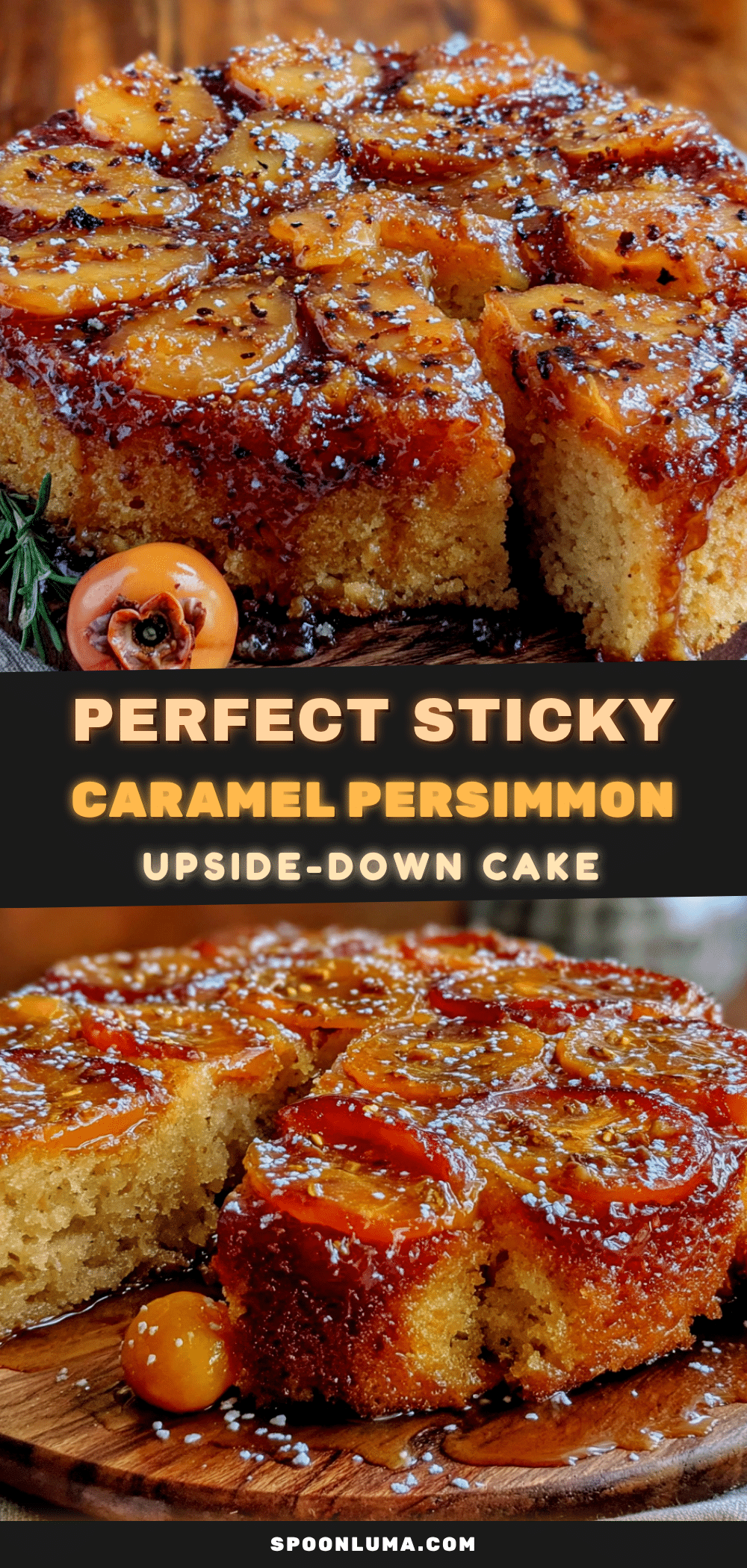
Best Easy Sticky Caramel Persimmon Upside-Down Cake
A stunning fall dessert featuring a deep amber caramel topping and beautifully arranged Fuyu persimmon slices. This moist, tender cake is perfect for gatherings and tastes even better the next day as the caramel soaks into the crumb.
- Prep Time: 20 minutes
- Cook Time: 50 minutes
- Total Time: 1 hour 10 minutes (plus 2 hours cooling)
- Yield: 10 servings 1x
- Category: Dessert
- Cuisine: American
Ingredients
- 1 cup (200g) granulated sugar
- 6 tablespoons (85g) unsalted butter, cut into cubes
- 1/4 cup (60ml) heavy cream
- 1/2 teaspoon vanilla extract
- 1/4 teaspoon salt
- 3–4 Fuyu persimmons
- 1 tablespoon lemon juice
- 1 1/2 cups (190g) all-purpose flour
- 1 1/2 teaspoons baking powder
- 1/2 teaspoon baking soda
- 1/2 teaspoon salt
- 1 teaspoon ground cinnamon
- 1/2 teaspoon ground ginger
- 1/4 teaspoon ground nutmeg
- 1/2 cup (113g) unsalted butter, softened
- 3/4 cup (150g) packed light brown sugar
- 2 large eggs, room temperature
- 1 teaspoon vanilla extract
- 1/2 cup (120ml) buttermilk, room temperature
Instructions
- Prepare the Persimmons: Wash the persimmons and cut off the tops. Using a sharp knife or mandoline, slice them into 1/8-inch thick rounds. Place the slices in a bowl and toss gently with the lemon juice. Set aside.
- Make the Caramel: In a small saucepan, spread the granulated sugar in an even layer. Cook over medium heat, without stirring, until the sugar starts to melt around the edges (about 3-4 minutes). Gently swirl the pan to help the sugar melt evenly. Continue cooking until the caramel turns a deep amber color (like an old penny). Immediately remove from heat. Carefully add the butter cubes—the mixture will bubble up vigorously. Whisk until the butter is completely melted and incorporated. Slowly pou…
- Arrange the Persimmons: Starting from the center of the pan, arrange the persimmon slices in concentric circles, overlapping them slightly. Press them gently into the caramel so they’re evenly coated. Set the pan aside.
- Make the Cake Batter: Preheat your oven to 350°F (175°C). In a medium bowl, whisk together the flour, baking powder, baking soda, salt, cinnamon, ginger, and nutmeg. Set aside. In a large bowl, beat the softened butter and brown sugar together on medium speed until light and fluffy, about 3-4 minutes. Scrape down the sides of the bowl. Add the eggs one at a time, beating well after each addition. Stir in the vanilla extract. With the mixer on low speed, add the flour mixture in three additions, …
- Assemble and Bake: Spoon the batter over the persimmon layer, spreading it gently and evenly. Use a spatula to smooth the top. Bake for 45-55 minutes, until a toothpick inserted in the center comes out clean or with just a few moist crumbs. If the top is browning too quickly (after about 30 minutes), tent it loosely with foil.
- The Flip: Let the cake cool in the pan for exactly 10 minutes. Run a knife around the edges of the pan. Place your serving plate upside down on top of the cake pan. With one hand on the plate and one on the pan, confidently flip the whole thing over. Lift the pan off slowly—if any persimmon slices stick, just press them back into place. Let the cake cool completely before slicing—about 2 hours.
Notes
The caramel is the most important part—cook it to a deep amber color for the best flavor. All ingredients should be at room temperature. Don’t overmix the batter. The 10-minute cooling time before flipping is critical. The cake tastes even better the next day. For gluten-free, use a 1:1 gluten-free flour blend. For dairy-free, use vegan butter and full-fat coconut cream.
Nutrition
- Serving Size: 1 slice (1/10 of cak
- Calories: 320
- Sugar: 24
- Sodium: 280
- Fat: 18
- Saturated Fat: 11
- Carbohydrates: 38
- Fiber: 2
- Protein: 4
Keywords: persimmon upside-down cake, caramel cake, fall dessert, persimmon recipe, upside-down cake, easy cake, sticky caramel cake